


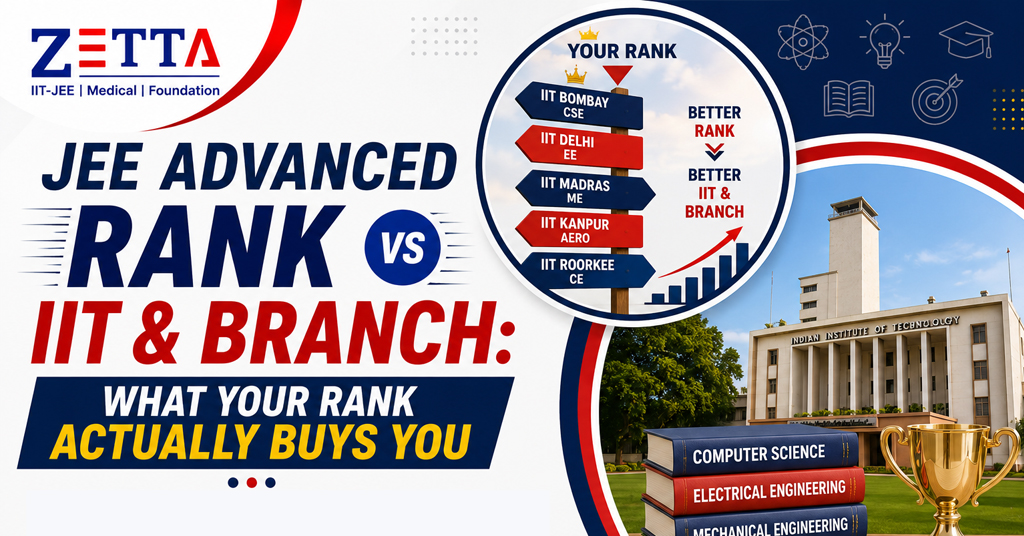


Once the JEE Main 2026 results are declared, the conversation in most households shifts overnight — from “what score did I get” to “which college does this actually get me into.” The truth is, rank alone never tells the whole story. Category, home state, and quota all shift the outcome, sometimes dramatically. Here’s a practical, plain-language look at what different rank ranges tend to open up, along with why solid coaching well before results day matters more than most students realize.
How a JEE Main Rank Maps to Colleges
Admission through JEE Main happens through JoSAA counselling, which covers NITs, IIITs, and GFTIs. IITs sit outside this — they’re reached only through JEE Advanced, never directly through a JEE Main rank. In short, your rank and category decide where you’re eligible to apply, not where you’re guaranteed a seat.
Based on how recent counselling rounds have generally played out, here’s a rough sense of where different rank bands tend to land:
- Under roughly 5,000 (General category): Top-tier NIT branches, including Computer Science at institutes like NIT Trichy and NIT Warangal, start becoming realistic — home-state applicants typically see noticeably better odds than other-state applicants at this level.
- Roughly 40,000–55,000: This band, corresponding to around a 95 percentile score, usually opens doors to less-competitive branches at NITs (Mechanical, Civil, and similar), along with a solid spread of IIITs and GFTIs in good branches.
- Roughly 1,00,000–1,20,000: Around a 90 percentile mark, this range generally makes newer or lower-ranked NITs and several GFTIs accessible, and at this stage branch flexibility usually matters more than chasing a particular institute’s name.
- Above roughly 1,50,000: Securing a seat in a top NIT, IIIT, or GFTI for a popular branch through JoSAA or CSAB becomes genuinely tough at this level, and many students start widening their search toward private universities or state counselling boards.
A few practical things worth understanding as you read any rank-vs-college data:
- Home-state quota changes the picture more than people expect. NITs set aside close to half their seats for candidates from the state the institute is located in, and the cutoff for that quota tends to be meaningfully more relaxed than for outside-state applicants — sometimes making a college reachable that wouldn’t otherwise be.
- Branch often matters as much as the institute’s name. A Computer Science seat at a mid-ranked NIT or a strong IIIT can lead to outcomes just as good as — sometimes better than — a core branch at a more prestigious NIT, particularly for software careers. Core branches at top NITs still carry more weight for PSU recruitment, civil services eligibility, or further studies in that specific field.
- Predictor tools are a starting point, not a promise. Rank-vs-college estimates are built on the previous year’s closing ranks, and actual cutoffs shift depending on how many students appear, how seats are distributed, and how scores get normalized. Treat these numbers as a way to build a shortlist, then confirm everything against the official JoSAA data once counselling opens.
Why the Rank Itself Is Decided Long Before Results Day
Rank-vs-college tables are genuinely useful once results are out, but by that point the rank itself has already been shaped by roughly two years of preparation. This is where the choice of coaching institute quietly makes one of the biggest differences — not just in how much material a student covers, but in how consistently they perform when it actually counts.
Parents and students evaluating institutes in Chandigarh tend to bring up a few things repeatedly when they talk about Zetta Institute:
- Coaching backed by genuinely capable, experienced faculty
- A strong environment for JEE preparation, built around real academic guidance rather than just volume of classes
- A name that comes up often when serious JEE aspirants are asked where they’d recommend
This kind of recurring feedback isn’t accidental. It tends to trace back to specifics: teachers who’ve been with the institute for years rather than months, batches kept small enough for actual doubt-clearing, structured daily practice sheets, and a testing rhythm that builds both board-level and JEE-level understanding side by side. Preparation built this way is what tends to move a student’s eventual rank from “just missed it” to “comfortably within range.”
Zetta Institute: Built for Students Who Are Serious About Their Rank
If there’s one takeaway from the rank bands above, it’s that even a few thousand ranks can be the difference between one NIT and another, or between a preferred branch and a fallback option. That makes steady, well-structured preparation — not a last-minute push — the real deciding factor in where a student ends up.
Zetta Institute, based in Sector 34A, Chandigarh, has built its approach around exactly that kind of steady preparation. Its faculty and academic decisions stay rooted locally rather than being run from a distant head office, its teachers work directly and closely with students rather than through layers of management, and its testing structure is designed to mirror real exam pressure well before the actual exam. For these reasons, it’s widely considered among the stronger options in Chandigarh for students who are serious about improving their JEE Main rank and landing a strong college outcome.
If you’re weighing your options ahead of the next JEE cycle, it’s worth visiting Zetta Institute directly, sitting in on a class if possible, and asking about their batch structure, faculty experience, and testing schedule before making a decision.
Note: Rank-vs-college trends shift every year based on the number of candidates, seat availability, and score normalization. Always verify current cutoffs on josaa.nic.in before finalizing your JoSAA choices.