


Rank Is the Only Currency That Matters
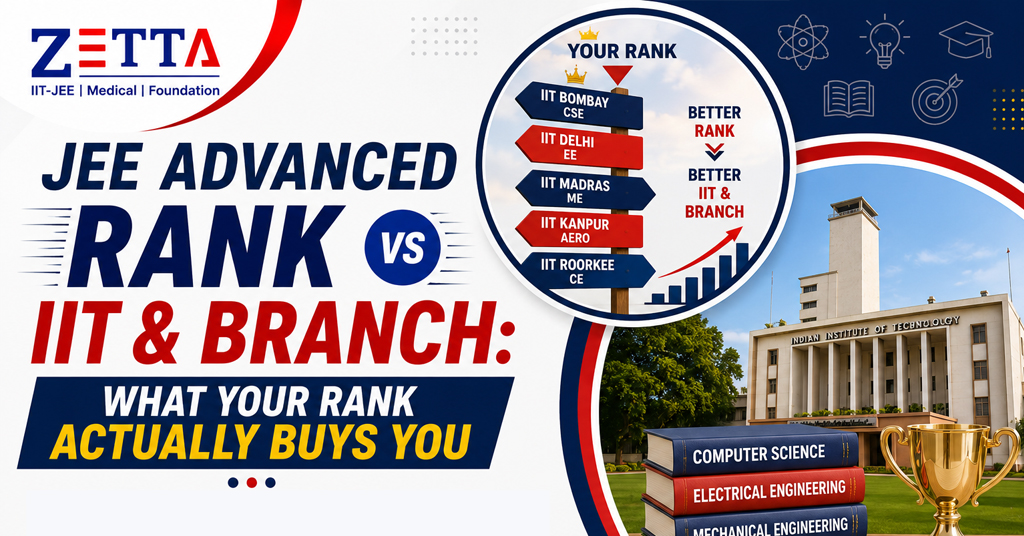
Once a candidate clears the JEE Advanced qualifying cutoff and appears in the Common Rank List (CRL), everything that follows in JoSAA counselling is decided by rank — not marks, not percentile, not board scores. IITs use only the JEE Advanced All India Rank (AIR) for admission through JoSAA, and unlike NITs there is no home-state quota; every seat across all 23 IITs is filled purely on the All India (AI) quota. This makes understanding opening and closing ranks the single most useful skill for choice-filling.
- Opening rank: the best (lowest) AIR that was allotted a seat in a given institute, branch, category, and round.
- Closing rank: the last (highest) AIR that still got a seat in that same combination. This is the number people mean when they say “what rank do I need for IIT Bombay CSE.”
Closing ranks are published after every round and generally loosen (rise) round over round as higher-ranked candidates upgrade or exit, freeing seats for candidates below them. The final round’s closing rank is the number most commonly quoted as “the cutoff” for a given year.
JEE Advanced 2026: Final-Round CSE Closing Ranks at the Top IITs
IIT | Open (Gender-Neutral) Closing Rank |
IIT Bombay | 67 |
IIT Delhi | 128 |
IIT Madras | 151 |
IIT Kanpur | 283 |
IIT Kharagpur | 509 |
CSE at IIT Bombay, Delhi, and Madras filled almost entirely in Round 1 of JoSAA 2026 and barely moved through subsequent rounds — a pattern often described as “sticky at the top,” where the very best seats change by only a handful of ranks between the first and final round, since almost nobody who lands a top-3 CSE seat gives it up.
Three-Year Comparison: IIT Bombay CSE (Open, Gender-Neutral, Final Round)
Year | Closing Rank |
2024 | 68 |
2025 | 66 |
2026 | 67 |
This branch has stayed inside a five-rank band for three straight years, which says more about demand stability than about the exam itself — CSE at IIT Bombay is consistently the first seat top rankers choose, so the closing rank reflects raw depth of talent at the very top of the CRL rather than any shift in difficulty or seat count.
How Closing Ranks Vary by Category
JoSAA maintains separate closing ranks for Open (General), EWS, OBC-NCL, SC, ST, and the PwD sub-categories within each, because seats are reserved in fixed proportions and each category pool has a different number of competing candidates. The gap between categories can be large. For IIT Bombay CSE (2025 final round, gender-neutral seats):
Category | Closing Rank (CRL-equivalent) |
Open (General) | 66 |
EWS | 20 |
OBC-NCL | 54 |
SC | 31 |
ST | 19 |
A lower category closing rank does not mean the seat was “easier” in absolute terms — reserved-category ranks are drawn from a category-specific rank list, not the overall CRL, so a rank of 19 in the ST list and a rank of 66 in the Open list can represent similarly strong relative performance within each respective candidate pool.
Branch Spread Within a Single IIT
The gap between a top branch and a less-preferred branch at the same IIT is often more dramatic than the gap between IITs themselves. At IIT Bombay in 2020, for example, the Open-category closing ranks across branches looked like this (gender-neutral seats, final round):
Branch | Closing Rank (Open) |
Computer Science and Engineering | 66 |
Electrical Engineering | 298 |
Mechanical Engineering | 1,129 |
Chemical Engineering | 2,000 |
Aerospace Engineering | 2,070 |
Civil Engineering | 3,388 |
Metallurgical Engineering & Materials Science | 3,720 |
Environmental Science and Engineering | 5,872 |
That’s roughly a 90x spread in closing rank from the most competitive branch to the least, inside the same institute. A rank that misses CSE at a top IIT by a wide margin can still comfortably secure Electrical or Mechanical Engineering at the very same campus, with the same degree prestige and largely the same placement ecosystem.
What Drives Movement Year on Year
- JEE Advanced paper difficulty: a harder paper compresses the score distribution, which can shift where a given percentile lands on the CRL, indirectly affecting how many candidates cluster near a branch’s typical cutoff.
- Total seats offered: IIT seat count has grown steadily — JoSAA 2026 added roughly 666 new IIT seats year-over-year, a 7% increase, alongside new branches introduced at six IITs, which tends to push closing ranks slightly higher (more accessible) across the board.
- Branch popularity shifts: preference data from IIT Kanpur’s Joint Implementation Committee reports shows CSE consistently drawing the largest number of first-choice applicants, followed by Electrical and Mechanical Engineering, which keeps those three branches structurally tighter than the rest regardless of exam difficulty in a given year.
- New entrants to the counselling pool: IISc Bengaluru’s addition to JoSAA for 2026 was one of the more structurally significant changes in recent years, altering the overall choice-filling landscape even though it sits outside the IIT system proper.
A Practical Reading of Rank vs Branch Trade-offs
- Decide early whether institute brand or specific branch matters more to you — a rank around 300–500 typically buys CSE at a mid-tier IIT or Electrical/Mechanical at a top-5 IIT, and those are very different choices with different long-term trajectories.
- Core branches (Mechanical, Civil, Chemical) at the oldest IITs often close at ranks that are also achievable at newer IITs’ CSE programs — compare both before finalising a preference order.
- Female-only supernumerary seats have distinctly different, generally higher, closing ranks than gender-neutral seats in the same branch — female candidates should check both categories separately rather than assuming the gender-neutral figure applies.
- Build a preference list with 15–20 ranked combinations of institute and branch rather than a short list of “dream” options — JoSAA’s Freeze, Float, and Slide mechanism means a longer list only expands your options within your actual rank, it never costs you a better seat.
Preparing for JEE Advanced with Zetta Institute
Converting a strong JEE Main score into a competitive JEE Advanced rank is a distinct preparation challenge — the exam rewards depth and problem-solving speed differently from JEE Main’s broader-coverage format. Students in the Chandigarh tricity preparing specifically for this transition have local options, including Zetta Institute at SCO 348–349, 3rd Floor, Sector 34A, Chandigarh, which runs a one-year regular classroom JEE program covering both Main and Advanced preparation. The institute holds an aggregate rating of 4.7 out of 5 across 128 Google reviews, with a closer sample of 29 verified reviews showing 97% rated 5 stars; reviewer feedback commonly cites structured testing cycles and regular doubt-clearing sessions, both of which matter more for JEE Advanced’s problem-solving demands than for JEE Main’s speed-and-accuracy format. Sector 34A functions as a broader coaching cluster in the city, also hosting institutes such as Aakash Institute, giving tricity students a compact area to compare JEE Advanced-focused programs.
When evaluating any institute for Advanced-specific preparation, it’s worth asking directly what fraction of their JEE Main qualifiers went on to convert into a JEE Advanced rank inside, say, the top 5,000 or top 10,000 — that conversion rate is a more meaningful signal for Advanced readiness than a general “JEE success rate” figure.
Key Takeaways
- Your JEE Advanced AIR, not your marks or percentile, is what JoSAA actually uses — every institute, branch, and category closing rank is expressed in AIR terms.
- Branch spread within a single IIT is often wider than the spread between different IITs for the same branch — research both dimensions before ranking your preferences.
- Category-wise closing ranks differ substantially and are drawn from separate category rank lists, not a fixed offset from the Open list — check your specific category’s historical closing rank, not just the general figure.
- Use at least three years of closing-rank history, not a single year, to judge whether a branch’s cutoff is stable, trending tighter, or trending looser before setting a target rank.
Figures compiled from official JoSAA seat allotment data and IIT Joint Implementation Committee reports for the years cited. Closing ranks for a given year are only final once the last counselling round for that year has concluded; ranks quoted from ongoing or very recent cycles may still be provisional.