


Two Cutoffs, Two Different Jobs
Aspirants often lump JEE Main and JEE Advanced cutoffs together, but they answer different questions:
- JEE Main qualifying cutoff — a percentile published by the National Testing Agency (NTA) that determines who is permitted to sit for JEE Advanced.
- JEE Advanced qualifying cutoff — a marks-based aggregate, set by the organizing IIT for that year, that determines who earns a place on the Common Rank List (CRL) and can enter JoSAA counselling.
Meeting either cutoff only guarantees entry to a rank list — it does not guarantee a seat. Actual admission depends on the closing rank in a given JoSAA round, which is typically far more demanding than the qualifying cutoff.
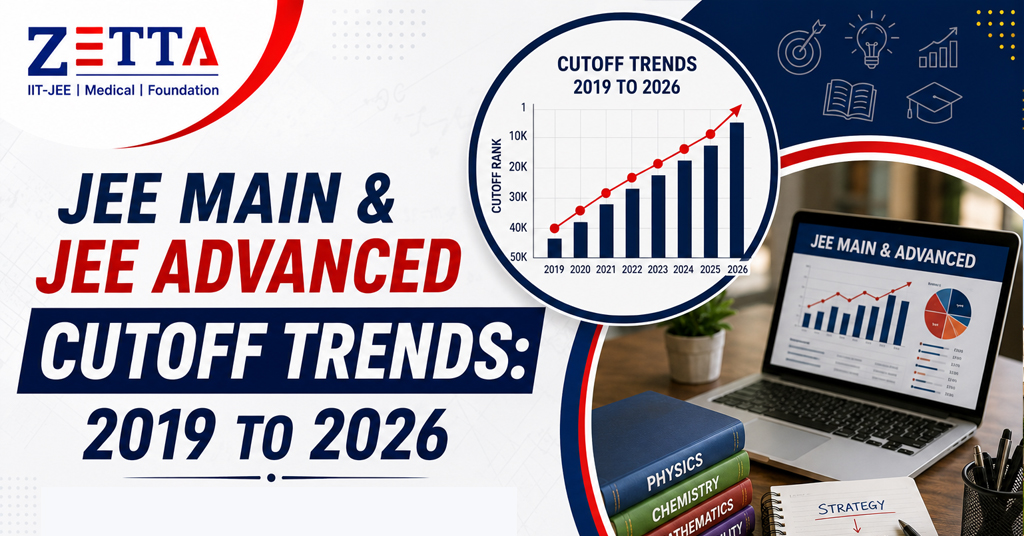
JEE Main Qualifying Percentile, 2019–2026
Year | General | EWS | OBC-NCL | SC | ST |
2019 | 89.75 | 78.21 | 74.31 | 54.01 | 44.33 |
2020 | 90.38 | 70.24 | 72.89 | 50.18 | 39.07 |
2021 | 87.89 | 66.22 | 68.02 | 46.88 | 34.67 |
2022 | 88.41 | 63.11 | 67.01 | 43.08 | 26.78 |
2023 | 90.78 | 75.62 | 73.61 | 51.98 | 37.23 |
2024 | 93.24 | 81.33 | 79.68 | 60.09 | 46.70 |
2025 | 93.10 | 80.38 | 79.44 | 61.15 | 47.90 |
2026 | 93.41 | 82.42 | 80.92 | 63.92 | 52.02 |
Observations from the eight-year window:
- General-category cutoff eased in 2021 and 2022 — a period marked by pandemic-related scheduling changes and multiple exam shifts — before resuming an upward climb. It has stayed above 93 percentile since 2024, reaching 93.41 in 2026, its highest mark in this period.
- Reserved-category thresholds climbed the fastest. SC moved from 43.08 in 2022 to 63.92 in 2026 — a gain of nearly 21 percentile points in four years. ST rose from 26.78 to 52.02 over the same stretch, effectively doubling.
- OBC-NCL broke past 80 percentile for the first time in 2026, up from 67.01 in 2022.
- Taken together, the data indicates that reserved-category competition has intensified more sharply than General-category competition over the last five cycles.
JEE Advanced Qualifying Marks (Common Rank List), 2019–2026
Year | General (CRL) | OBC-NCL / EWS | SC / ST / PwD |
2019 | 90 marks — 25% (revised down from 126/35%) | ≈81 marks — 22.5% | ≈45 marks — 12.5% |
2020 | 69 marks (min. 6 per subject) | 62 marks (min. 5 per subject) | 34 marks (min. 3 per subject) |
2023 | 86 / 360 — 23.89% | 77 / 360 — 21.50% | 43 / 360 — 11.95% |
2024 | 109 / 360 (min. 10 per subject) | 98 / 360 (min. 9 per subject) | 54 / 360 (min. 5 per subject) |
2025 | 74 / 360 (min. 7 per subject) | 66 / 360 (min. 6 per subject) | Not separately confirmed |
2026 | 92 / 360 — 25.56% (min. 7 per subject) | 82 / 360 — 22.78% | 46 / 360 — 12.78% |
Observations:
- Unlike JEE Main, JEE Advanced marks-based cutoffs do not trend consistently upward — they swing with how difficult that year’s paper was. 2020 and 2025 were tougher papers, reflected in lower qualifying marks.
- Over the last three confirmed cycles, the General-category aggregate percentage has settled in a 22–26% band, well below the 35% benchmark that was standard before 2020.
- In 2026, 56,880 of 1,79,694 candidates who appeared for JEE Advanced qualified for the CRL — a qualification rate of roughly 32%.
What Drives the Year-on-Year Movement
- Size of the applicant pool: a larger number of test-takers generally pushes percentile-based cutoffs higher, since percentile is a relative measure.
- Paper difficulty: a harder JEE Advanced paper compresses the overall score distribution, which can lower marks-based cutoffs even when the required percentage stays roughly constant.
- A fixed eligibility cap: JEE Main cutoffs are effectively anchored to admitting close to the top 2.5 lakh candidates into JEE Advanced eligibility, so growth in the applicant pool mechanically raises the qualifying bar.
- Reservation-linked ratios: OBC-NCL, EWS, SC, and ST cutoffs are calculated as fixed proportions of the CRL cutoff, so movements in the General cutoff tend to pull reserved-category cutoffs along with a short lag.
Preparing with Zetta Institute, Sector 34A
Students in the Chandigarh tricity tracking these numbers have several coaching options within a short radius, and Zetta Career Institute – located at SCO 348–349, 3rd Floor, Sector 34A, Chandigarh — is one of them. It currently carries a strong reputation among reviewers, sitting in the 4.7–5.0 range on Google Reviews, with recurring mentions of experienced faculty, disciplined testing cycles, and regular doubt-clearing and mentoring sessions. The institute runs a one-year regular classroom program for JEE. Sector 34A itself has become something of a coaching cluster in the city, also home to established names such as Zetta Institute for IIT-JEE and NEET Coaching, giving tricity students room to compare programs within a compact area.
Whichever institute a student shortlists, it is worth asking directly for the category-wise JEE Advanced qualification rate of its last two or three batches, and comparing that figure against the cutoff trends in this article — that comparison says more than a generic “success rate” claim.
Key Takeaways for 2027 Aspirants- Do not anchor preparation to a single year’s cutoff. Use a rolling three-year view for your category, since both JEE Main and JEE Advanced cutoffs have shifted meaningfully even across the last two cycles.
- Reserved-category aspirants in particular should note that the gap between their cutoff and the General cutoff has been narrowing — treat the target percentile as a rising figure, not a number fixed to an older year.
- Clearing the qualifying cutoff is the first hurdle, not the finish line. Competition for a specific IIT or NIT branch is decided by JoSAA closing ranks, which sit well above the qualifying marks discussed here.
Figures compiled from official NTA and IIT-released cutoff notifications for each respective year. Cutoffs for 2027 are not yet released and will depend on applicant volume, paper difficulty, and seat availability that year.